
AZZEDINE ALAÏA AND AFRICA
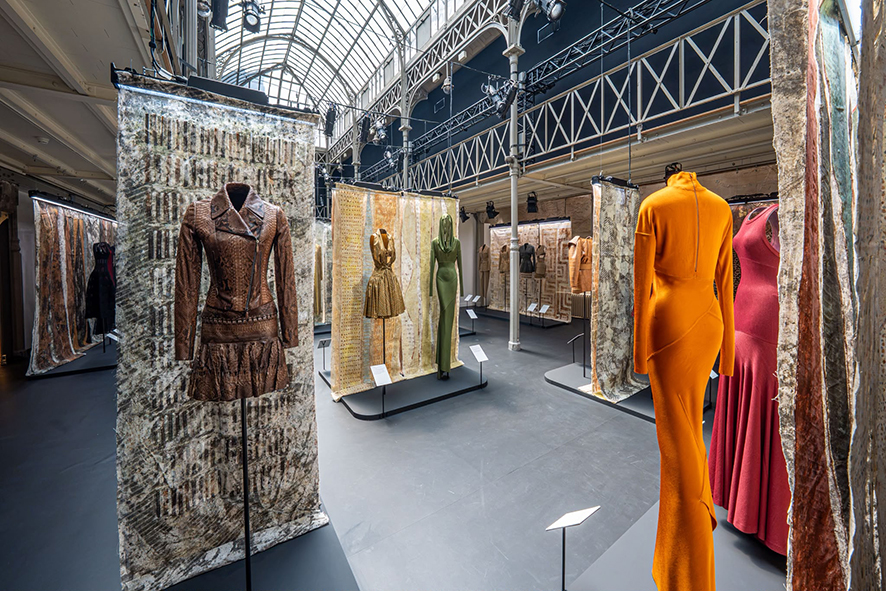
"AZZEDINE ALAÏA AND AFRICA" ph. Stéphane Aït Ouarab
Although he earned recognition and legitimacy in the world of French haute couture, Azzedine Alaïa stayed committed throughout his career to drawing on inspiration from a country – and a continent – that he had left at a young age but that never stopped fascinating him.
With a sense of nostalgia, the mashrabiyas come to mind, just as they did when he was a child in Tunis. These finely crafted lattice screens, which sculpt both light and gaze, find a kind of rebirth in Alaïa’s designs. Rendered in white cotton – even more striking than the limewashed walls of his native Tunisia – the designer plays a game of hide-and-seek with bodies and fleeting silhouettes. Openwork hems on skirts and shirts reveal and conceal, just as they once did. Those same limewashed façades – traditionally splashed with cool water in summer to refresh interior courtyards – inspired the couturier to capture both fragrance and sensation. Their dazzling brightness, combined with the lightness of fabrics seemingly yearning for the rare breeze of warm lands, would remain a constant throughout his work. From North Africa and its people, he also retained the memory of simple jackets, from underneath which long striped shirts emerge – proudly worn by the models in his 1992 collection.
AZZEDINE ALAÏA AND AFRICA- VIDEO: SYLVIE DELPECH
In apparent contrast to these sunlit whites, Azzedine Alaïa also explored every nuance of black. From the most radiant to the deepest shade, black imbues the movement of the body with a warm ink-like quality that simultaneously protects and shapes majestic silhouettes, as seen in his 1983 and 1984 collections. Sovereign heads are wrapped in hoods, while gestures adopt the fluid principles of unruly fabric. From the visual language of leather masks, and dark, burnt wood masks, he retained a sense of stylistic economy. Certain dresses, deliberately simple in appearance, become countenances in their own right through the expressive power of the materials used.
All the sandy hues of sub-Saharan Africa are subtly evoked, echoing the nuances of landscapes that seem to dissolve into intense reds. Raffia and twine give free rein to the imagination, used in dresses that the couturier conceived to be entirely adorned with embroidery featuring seashells and cowrie shells for three collections deeply marked by an African influence: Spring/Summer 1988, 1989, and 1990.
It was through imagery of Egypt and the secret art of mummification that the couturier took a closer, fresh look at the art of cutting – a skill that he mastered like few others. From this iconographic research emerged some of Alaïa’s most iconic creations. His bandage dresses (first introduced in 1985) were true feats of construction that he invented from scratch, and which perfectly showcase the virtuosity of a designer perpetually captivated by the legacy of queens and pharaohs.
Conceived by Kris Ruhs, the paintings accompanying the exhibition enter into dialogue with the works of Azzedine Alaïa, creating a sensory landscape where art and fashion resonate with one another.
The exhibition continues on the first floor with a selection of photographs by Peter Beard. In April 1996, the couturier traveled through Maasai country with the photographer Peter Beard.
GUIDED TOURS OF THE EXHIBITIONS
The Foundation offers guided tours of the current exhibition at 18 rue de la Verrerie in partnership with the cultural mediation agency Des Mots et des Arts which organizes tours led by professionals specializing in fashion history. They offer visitors an overview of the current exhibition, the life and work of Azzedine Alaïa, as well as the location’s history and architecture.